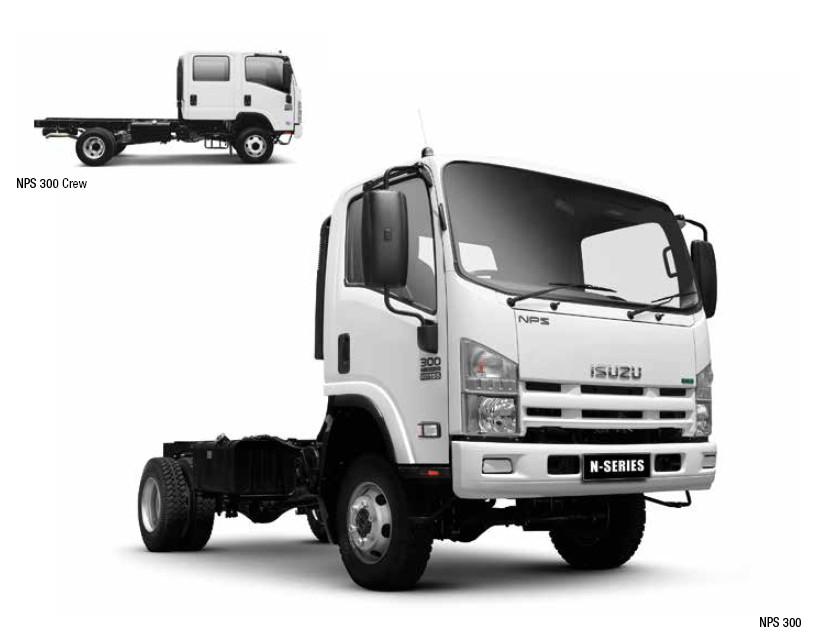
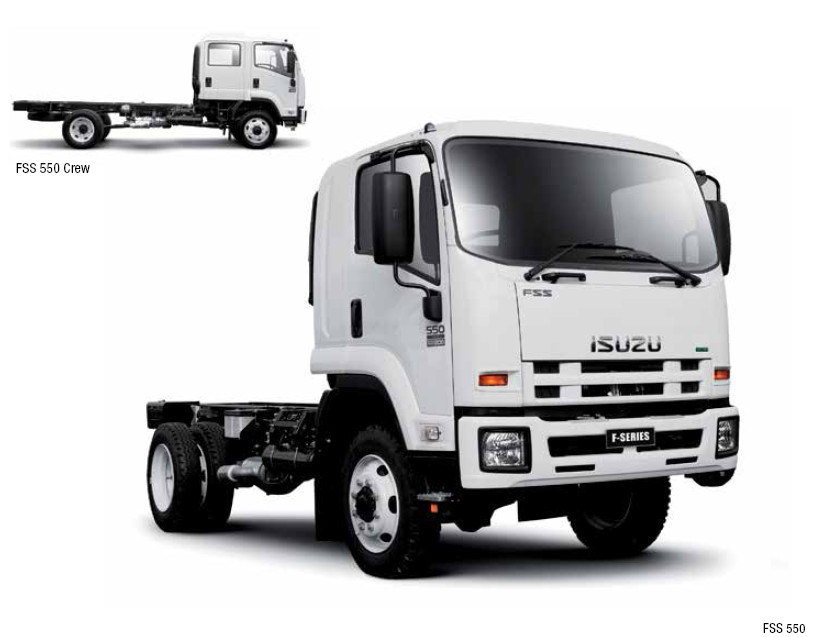
Isuzu F-series, N-Series 4x4 truck
Isuzu’s 4x4 F-Series is the preferred vehicle of choice by many rural fire authorities and is also popular with councils and those who have to work off the beaten track. The original FTS 800 had conventional leaf springs and a part-time 4WD system and so wasn’t driver and crew friendly, but progressive upgrades see the current model with taper-leaf front springs and full-time 4WD. Ride quality is still firm, but not as jarring as before and driveability is eased by the full-time 4x4 system. Other improvements to the FTS 800 include driver airbag and seatbelt pre-tensioner, an ISRI 6860 driver’s seat and cruise control.
Like the manual-transmission model the FTS 800 Auto is available with a short-sleeper cab or a crew cab. The automatic transmission is an Allison LCT 2500, five-ratio box that links electronically to a proved Isuzu 7.8-litre turbo-diesel, with outputs of 176kW (235hp) and 706Nm.
The standard manual transmission is an Isuzu six-speed manual (five ratios synchronised) with a tall overdrive top gear (0.72:1) and a constant-mesh first gear with 6.6:1 gearing. The manual-box FTS 800 has excellent crawl capability thanks to a low-range reduction of 1.9:1 and final drive ratios of 5.57:1. Overall crawl gearing is 70:1, allowing walking pace progress up and down steep grades.
To show off its new automatic-transmission 4WD truck Isuzu put on a drive day at Victoria’s Australian Automotive Research Centre, near Anglesea in Victoria. The weather was drizzly rain that turned clay slopes into skating rinks.
The test truck was a single-cab tray model, loaded to 12.9 tonnes.
When venturing off-road in the FTS 800 the truck needs no 4WD selection, but the driver can lock the centre differential for additional traction and then choose low range for stump-pulling toque and crawl capability. The standard rear axle differential is a self-locking ‘No-Spin’ that requires no driver intervention.
The manual box FTS 800s we’ve driven in the past were easy enough to operate, with the only possible difficulty for novice drivers being the need to double declutch and match revs to pick up first gear on the move.
The automatic box shifted superbly on this test, but there’s no such thing as a free lunch: in exchange for hands-free and foot-free shifting the automatic transmission sacrifices some low-speed capability.
With a torque converter stall ratio of approximately 1.8-2:1 the auto model has overall gearing reduction that’s almost identical to the manual’s, so uphill climbing ability is about the same. We found it possible to idle the loaded auto FTS 800 up slopes that were too steep to stand on, but it was a different story when descending those grades.
Torque converter stall doesn’t apply when running downhill, so the effective gear reduction changes to only half that of the manual vehicle’s and so it tried to run away on downgrades that would see the manual creeping down in low gear. In the auto it was necessary to use the service brakes to control speed
OTA reckons that operators who work in very steep conditions – like the Victorian High Country – would be best served by the manual-transmission FTS 800, but those who don’t need powerful downhill gearing have the choice of both boxes.
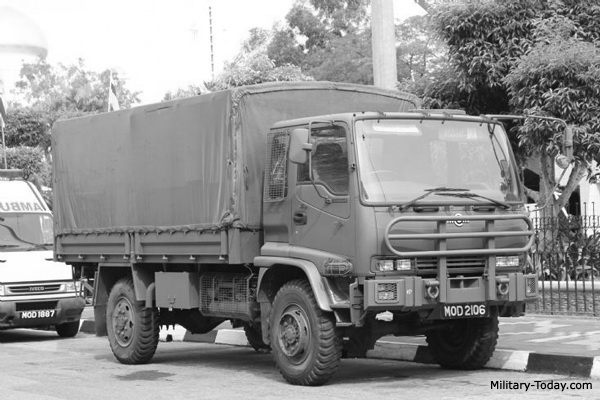
The Handalan light military truck was developed by HICOM of Malaysia in cooperation with Isuzu of Japan. It was first revealed in 1996. Initially it was known as FSS 32G.
| Внедорожные траспортные средства (Land Locomotion – Mechanical Vehicle Mobility LL-MVM) Home |